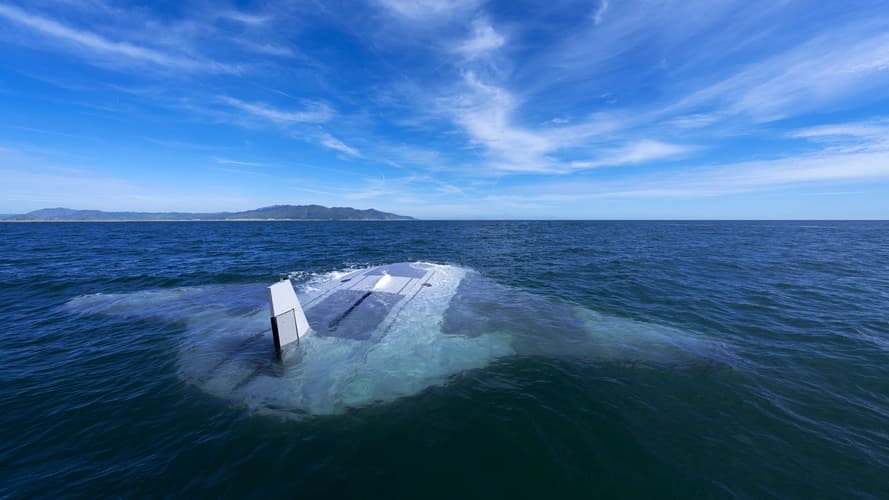
WASHINGTON/TEHRAN: In a major technological escalation to secure critical global energy routes, the United States military is reportedly mulling the deployment of several ‘Manta Ray’ Unmanned Underwater Vehicles (UUVs) to the highly volatile Strait of Hormuz. The strategic move comes just days after a commercial oil tanker suffered a catastrophic explosion after striking a suspected naval mine in the contested waterway.
Manta Ray: A Next-Generation Deep-Sea Sentinel
The Manta Ray is a highly advanced, prototype autonomous submersible developed by defense contractor Northrop Grumman under a Defense Advanced Research Projects Agency (DARPA) initiative. Successfully undergoing full-scale, in-water testing off the coast of Southern California in early 2024, the drone has now rapidly transitioned from an experimental project to a frontline naval asset.

Inspired by its biological namesake, the UUV utilizes a sleek, lifting-body design that mimics the graceful glide of a real manta ray, providing incredible hydrodynamic efficiency and natural camouflage. While much of its technology remains classified, defense analysts estimate the massive drone weighs approximately 30 tons, boasts an operational range of 10,000 nautical miles, and possesses a 10-ton payload capacity capable of carrying advanced sonar, radar, and cameras.
Unprecedented Endurance and Stealth
The most revolutionary aspect of this drone is its ability to operate independently for extended periods without human intervention. To achieve extreme endurance, the drone leverages buoyancy-driven gliding to move through the water efficiently rather than relying solely on traditional propellers. Furthermore, the vehicle can physically anchor itself to the seafloor and enter a low-power “hibernation” state, vastly extending its mission lifespan while remaining completely undetected.

Maintaining stealth communications is notoriously difficult underwater. To solve this, defense experts suggest the Manta Ray can deploy “data bubbles”—tiny electronic storage devices that the UUV releases while remaining safely hidden in the depths. These bubbles float to the surface and transmit critical intelligence back to naval command via satellite.
ALSO READ: Another Indian Sailor Confirmed Dead in Strait of Hormuz Following Missile Strike on MV GFS Galaxy
Modular Deployment to the Middle East
Deploying extra-large UUVs traditionally required specialized port facilities and heavy logistical support. The Manta Ray entirely bypasses this hurdle through a first-of-its-kind modular design.

The drone is designed to be broken down into subsections, packed into standard shipping containers, transported globally, and rapidly assembled directly in the field. By deploying the Manta Ray directly into the Persian Gulf rather than navigating it from a distant port, the U.S. Navy conserves the energy the drone would have otherwise wasted in transit.
Now actively hunting for naval mines in the Strait of Hormuz, the Manta Ray represents a massive shift in subsea warfare, allowing the U.S. military to detect and neutralize underwater explosives while keeping human sailors entirely out of harm’s way.