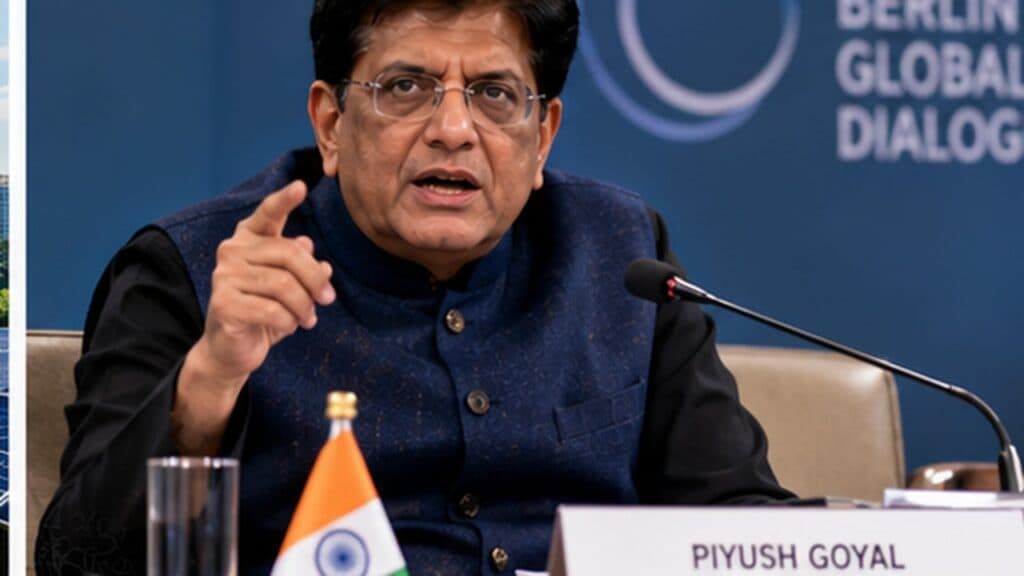
Berlin, October 23, 2026: Union Commerce and Industry Minister Piyush Goyal has sharply criticised European countries over their historical contribution to global carbon emissions and questioned their climate commitments, accusing developed nations of failing to provide adequate financial support to developing economies while imposing costly environmental regulations on their exports.
Speaking at the Berlin Global Dialogue in Germany on Thursday, Piyush Goyal challenged the European Union’s Carbon Border Adjustment Mechanism (CBAM), arguing that its carbon-related costs and restrictions on steel imports risk making European industries less competitive, increasing consumer prices and creating additional barriers to international trade.
“Who’s responsible for this mess in the first place?” Goyal asked during a roundtable discussion, questioning the historical responsibility of developed countries for climate change.
View tweet
The minister argued that India, despite accounting for around 17 per cent of the world’s population, contributes a comparatively small share of global carbon emissions. He also said Europe’s per-capita contribution to emissions and environmental impact was substantially higher than India’s.
According to Goyal, the burden of climate action must reflect countries’ historical emissions, economic circumstances and development needs.
Piyush Goyal Questions Europe’s Climate Responsibility
Piyush Goyal said developed countries had benefited from decades of industrialisation and the use of relatively inexpensive energy, while developing economies such as India were still working to meet the energy, infrastructure and livelihood needs of large populations.
He argued that countries with greater historical responsibility for climate change should do more to support vulnerable nations and emerging economies in their transition towards cleaner energy.

The minister said India had to balance environmental commitments with the need to provide energy security, food security and better living standards to its population of approximately 1.4 billion.
He also highlighted India’s expanding clean-energy programme and efforts to reduce the emissions intensity of industrial production, including initiatives to make steel manufacturing greener.
Goyal’s remarks underline a long-standing disagreement between India and several developed economies over how the costs of climate action should be distributed.
‘Inviting Disaster’: Goyal Targets EU Carbon Border Tax
In a separate intervention at the Berlin Global Dialogue, Piyush Goyal described the EU’s carbon border mechanism and restrictions on steel imports as counterproductive.
“If you have put a CBAM on yourself, you put a 50% import duty to bring steel into your country, you are inviting disaster. Your cost of living will go up. Your people will be unhappy. Your industry will be out-priced,” he said.

The minister warned that higher costs for steel, aluminium and cement could affect a wide range of European infrastructure projects, from airports and ports to roads, utilities and water pipelines.
He also criticised what he described as an expanding web of European regulations, arguing that additional compliance requirements could increase the burden on businesses and undermine their ability to compete in global markets.
Piyush Goyal cautioned that trade restrictions could invite reciprocal measures from other countries, potentially hurting exporters and businesses on both sides.
What Is the EU’s CBAM?
The Carbon Border Adjustment Mechanism is the European Union’s policy to address carbon emissions associated with certain imported goods. It is designed to align the carbon costs of covered imports with those faced by domestic producers under the EU’s climate policy framework.
The mechanism covers sectors including iron and steel, aluminium, cement, fertilisers, electricity and hydrogen.
The EU’s definitive CBAM regime began on January 1, 2026. For Indian exporters, the mechanism raises concerns about additional costs, emissions reporting requirements and the competitiveness of carbon-intensive products in the European market.
India has argued that such measures should account for differences in national circumstances and the historical responsibility of developed economies. The EU, meanwhile, presents CBAM as a tool to prevent carbon leakage and ensure that domestic producers are not disadvantaged by stricter climate rules.
‘We Haven’t Seen a Dime’: Piyush Goyal Revives Climate Finance Dispute
Piyush Goyal also questioned whether developed countries had fulfilled their commitments to provide climate finance to developing and vulnerable nations.
Referring to the long-standing pledge by developed countries to mobilise $100 billion annually for climate action in developing economies, he said that the support had not adequately reached countries that needed assistance.
“Eleven years later, we haven’t seen a nickel or a dime of that. It’s all promises,” he said, criticising what he described as the gap between international climate commitments and their implementation.
The $100 billion annual climate-finance goal originated in negotiations before the 2015 Paris climate agreement. Developed countries had committed to mobilising the funding by 2020, with the goal subsequently extended through 2025.
The broader dispute concerns not only the amount of finance delivered but also its accessibility, the balance between grants and loans, and the availability of technology to help developing countries reduce emissions while continuing to grow.
Piyush Goyal argued that developed economies should provide meaningful financial and technological assistance instead of imposing measures that could make industrial development more expensive for emerging markets.
India-EU Trade Ties Add to the Significance
The minister’s remarks come as India and the European Union seek to strengthen their economic relationship through a proposed free trade agreement.
Piyush Goyal said the agreement could move towards signing by the end of 2026 and become operational in the first quarter of 2027, subject to the remaining processes and requirements.
The proposed agreement is expected to expand market access and strengthen cooperation in manufacturing, technology and investment. However, differences over climate-related trade measures remain an important issue for Indian exporters, particularly in carbon-intensive sectors.
Piyush Goyal has argued that India wants access to European technology that can help it manufacture green hydrogen and lower-carbon steel more competitively. He said trade and climate policies should facilitate industrial cooperation rather than raise costs for businesses.
The minister has also stressed that India is pursuing partnerships with multiple countries and regions, rather than relying on a single market.
Climate Action Versus Trade Barriers
The remarks reflect a wider debate over whether carbon border measures can effectively address emissions without creating new trade barriers.
Supporters of CBAM argue that it discourages companies from shifting production to countries with less stringent climate policies and helps protect European manufacturers that face carbon costs at home.
Critics, including India, contend that such mechanisms can disproportionately burden developing-country exporters and fail to adequately recognise differences in historical emissions, income levels and access to cleaner technology.
The disagreement is rooted in the principle of “common but differentiated responsibilities” under international climate negotiations. The principle recognises that all countries have a role in tackling climate change, while their responsibilities and capacities differ.
Piyush Goyal’s intervention in Berlin signals that India intends to continue pressing developed economies on climate finance, technology transfer and the trade implications of environmental regulations.
As the India-EU trade negotiations progress, the challenge will be to reconcile the bloc’s decarbonisation objectives with India’s demands for equitable treatment and affordable access to international markets.