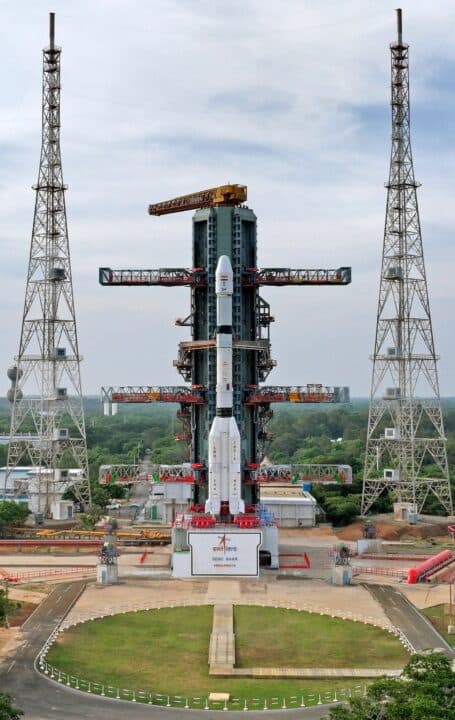
Sriharikota, October 29, 2026: The Indian Space Research Organisation (ISRO) is set to launch its NVS-03 navigation satellite aboard the GSLV-F18 rocket on Friday, October 30, in a mission aimed at strengthening India’s regional satellite-navigation system, NavIC.
The launch is scheduled for 11:51 pm IST on October 30 from the Second Launch Pad at the Satish Dhawan Space Centre in Sriharikota, Andhra Pradesh.
The mission will mark the 20th flight of India’s Geosynchronous Satellite Launch Vehicle (GSLV) and is part of efforts to ensure continuity of navigation services provided by the Indian Regional Navigation Satellite System, now known as Navigation with Indian Constellation (NavIC).
View tweet
According to ISRO, the NVS-03 satellite is the third spacecraft in the next-generation navigation satellite series. It is designed to strengthen the system’s capabilities and support positioning, navigation and timing services across India and a region extending approximately 1,500 km beyond the country’s borders.
What Is the ISRO NVS-03 Mission?
NVS-03 is part of India’s effort to modernise and maintain its independent regional navigation infrastructure.
NavIC provides positioning and timing information for applications including transportation, maritime navigation, emergency services, surveying and location-based systems. It is intended to serve India and the surrounding region rather than provide global coverage like the US Global Positioning System (GPS).

The second-generation NVS satellites are designed to improve the system’s capabilities and ensure the continuity of services as older satellites reach the end of their operational lives.
The launch will place NVS-03 into a Geosynchronous Transfer Orbit, after which the satellite will undergo further orbital manoeuvres before reaching its intended operational position.
Indigenous Atomic Clock and New Navigation Signal
One of the important features of NVS-03 is its onboard atomic-clock system, which includes an indigenous atomic clock alongside procured clocks.
Precise timing is essential for satellite navigation because receivers calculate their positions using signals transmitted by multiple satellites. Even small timing errors can affect positioning accuracy.
The satellite will also introduce the L1 frequency band alongside the L5 and S-band signals used by the existing NavIC system.
The additional signal is intended to broaden compatibility with navigation receivers and support a wider range of civilian applications.
Together, these features are expected to strengthen NavIC’s technical capabilities and support its use in transportation, logistics and other location-based services.
Why Is the ISRO NVS-03 Launch Important for India?
India relies heavily on foreign satellite-navigation services for a range of applications. Strengthening NavIC gives the country greater control over a regional navigation system designed around its own operational requirements.
A more capable constellation can support applications such as vehicle tracking, maritime navigation, disaster management, precision timing and location-based services.
Navigation technology is also relevant to railway operations. A robust satellite-navigation system can support real-time tracking and timing applications, although individual services depend on receiver compatibility, system coverage and the availability of operational satellites.
The NVS-03 mission is therefore part of a broader effort to maintain a reliable navigation infrastructure for government, commercial and civilian users.
ALSO READ: ISRO ‘Brain Drain’ Gaganyaan Mission Under Threat? Urgent Memo Issued
A Key Step After the NVS-02 Setback
The mission follows the failure of the NVS-02 satellite to reach its intended orbit after its launch in January 2025.
According to the analysis of that mission, a drive signal was not delivered to a pyro valve in the engine’s oxidiser line during the orbit-raising operation. The malfunction prevented the spacecraft from completing the required manoeuvre.
ISRO subsequently reviewed the failure and introduced corrective measures recommended by the committee examining the mission.
The upcoming NVS-03 launch is an important opportunity to strengthen the constellation after that setback. However, its success will depend on the launch vehicle placing the satellite into the intended transfer orbit and the subsequent orbital operations proceeding as planned. <Cite refs={[“turn594860search8″,”turn594860search12″,”turn594860search17”]}/>
What Happens After Launch?
After liftoff, the GSLV-F18 rocket is expected to carry NVS-03 into Geosynchronous Transfer Orbit.
The satellite must then complete orbital manoeuvres and system checks before beginning operational service. The launch itself is therefore only the first stage of the process; successful deployment and commissioning will be necessary before the satellite can contribute to NavIC services.
ISRO is expected to provide mission updates through its official channels during the launch and subsequent operations.
The scheduled launch time may change depending on technical and operational conditions, so viewers should check the space agency’s latest announcements before making plans to watch the event.